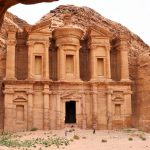
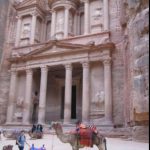
I had travelled to Petra three or four times before moving there in the spring of 2008
Initially my work involved setting up and running a hotel in Wadi Musa but it was inevitable that I would become more involved in cooking. I had already spent most of my adult life living on hommus and baba ganuj so the transition to Jordanian food was effortless. The only taste I missed was tea. Friends sent me food packages of Earl Grey and I sent them spices and jasmine flowers in return.
All recipes alter as they travel, they absorb local flavours and incorporate new ingredients replacing the exotic regional foods. In some cases a dish can become unrecognisable as it travels hundreds of miles. Most Chefs, including myself, look to the original, the classic, as a starting point. My Art teacher is fond of saying “nothing bad ever came from a good drawing†and, I feel the same way about having a solid understanding of a classic dish. Nothing inedible will ever come of it. It is advisable, I think, to never try to deconstruct something unless you first know how to put it together!
Homous means pea in Arabic and in case you are wondering it can be spelt in a variety of ways. Translations only work for pedants when they use a common alphabet if not then the word is translated phonetically. Therefore it rather depends on the dialect as to how you, personally chose to spell it. Humus has endless variations in the west which usually involve adding extra flavours. In Arabia the differences tend to me more about texture. My favourite is Umsubaha; a smooth puree which most people would recognise as hommous with the addition of chunky cooked chickpeas. I love the satisfying pop of a whole chickpea. It is usually served with lots of olive oil or zay zaytuna and sumaq which is taken from the fruit of the tree and adds a lemony zing. In all my time in Jordan I never saw garlic or tahini added to houmous. But this maybe because I was living amongst partly settled Bedou and Howeitat tribes who are never more than a suggestion away from a journey. Simple is good and complicated unnecessary in the desert. Nomadic hommus is chickpeas, oil, salt and lemon if you have it.
Ful medame is served at breakfast, it is cooked and mashed fava beans sometimes chopped tomatoes are added at the end. It is served with boiled eggs and shraq bread. In that sense it equals the western world’s beans and egg start to the day. There really is nothing new under the sun and I always find that travel highlights similarities rather than differences.
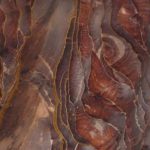
I attended a few cookery classes in Wadi Musa but I always felt that I learnt more from watching friends and their families cook. I was lucky enough to be involved in the Wadi Rhum marathon, horses from all over the Arabic peninsular compete in a two day endurance and speed competition. We followed in a 4×4 carrying water and dibs for the horses and riders. On the first night we camped at the base of the Seven Pillars of Wisdom waiting to begin the race at sunrise. After the horses were fed and watered we collected sticks from dry dessert bushes for a fire. Tomatoes and onions were chopped and added to a large pot. It takes an age to cook Galayat bandura with twigs. The onions need to dissolve to nothing, various friends would taste the dish and declare that the onions could still be discerned and so the cooking went on. It was my first lesson in the fussiness of cooks. Food in the dessert takes as long as it takes and when you only have a couple of ingredients how they taste is all about the quality of the cooking. We chomped on fustuk and sedera until after midnight when this simple stew was ready. Jordan is famous for its elaborate whole goat meals buried in hot sand and cooked for hours or days but I have always found more pleasure in simple food with lots of love attention poured over it.
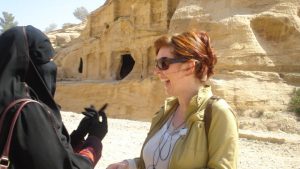
Wadi Araba is the barren valley that sits between Jordan and Israel. It is separated by the slither of water that is the biblical River Jordan. It is not far from the Mountains of Wadi Musa and with its proximity to the Dead Sea it was my favourite location on a day off. I had begun at sunrise and visited the stones salt pillars of Lot and his wife so that I could be heading down from the high place well before the tourist coaches turned up. I scrambled my way in to the valley and out on a to miraged plain with nothing to discern but sand and the odd scratch of a juniper tree. It takes a long time for your eyes to acclimatise to the dessert. At around midday I was aware I needed to look for a tree to rest under until the heat passed. I realised that what I had thought were the shadows of a tree were in fact two ladies in black dishdashs. The wreaths of smoke from their fire mixed with the trembling layer of heat as it left the sand The Qu’ran advises that a stranger who passes you should be offered water and food, bread at the very least. It is a bargain of hospitality which goes both ways. The obligation for the traveller is to be sociable, maybe to tell a story or at least wile away a few hours in company. I have seen people, usually those who do not know the culture, take this hospitality as a free buffet and it greatly annoys me to witness this. Muhammed PBUH did not foresee thousands of affluent tourists generously being offered food by proud people with little money. With this always in mind I sit on the half shadowed sand and take a small sip of water. The branches of tree are festooned with what few possessions the ladies own. Two handbags, a packet of cigarettes, and a leather pouch made of a camel’s stomach. Around the fire is a low circle of stones and resting on it a pan which resembles an upturned wok. Both ladies are dressed in plain black. I realise that they are mother and daughter. Uma’s face is a relief map of lines etched as deeply as the valley itself. Her small deep-set eyes, lost beneath the folds of her eyelids, are at the same time intimidating and kind. She shows the beneficent scrutiny of someone far too old to be concerned with superficiality. Her Daughter has the bright orange hair of a woman stubbornly attached to henna and I should know. Henna gives a luscious red tone to dark hair but as it goes grey it becomes the vibrant orange of a clowns wig. Her name is Maha and we chat in basic Arabic as she mixes the dough, adding water to her hands to make a sloppy mess in a round brass coloured platter. It is like wallpaper paste she adds more flour from a sack beside her, bringing it together before moulding it into balls and passing it to her mother. Uma makes a shape similar to that of a pizza maker. She has the dexterity of a young woman. She throws the thin dough on the metal dome and it instantly begins to crackle and blister. After half a minute she picks up one end and turns it over in the air before throwing it back down on to the hot metal. This is shraq. In my opinion the best bread in the world. It’s rare to find in Jordan now. There is a shop in Amman where people queue around the block from sunrise and walk out with shraq rolled in brown paper the same size and shape as six baguettes. Hubus is usual bread that you will find everywhere and it is much thicker and leavened like a  focaccia. There is also Bedouin bread which is the colour of old leather and so large you could saddle a horse with it.
I have never found it difficult to converse with people who don’t speak the same language even though I have little Arabic and they have no English we understand so much from tone and signs. The basic questions on meeting strangers are as carved in stone as the Decalogue. Where do you come from, where are you going, how old are you, are you married, do you have children?. In the West the first question is “What do you do? That question never crosses my mind in the desert.
We sit the on the sand until the midday begins to develop colour and gives way to afternoon. The only inhabitants of a vast beach lower than all the seas of the world. “Half as old as time” is the saying synonymous with Petra but could easily apply to us three. Time feels as though it has become redefined below this black tree garlanded bejewelled with handbags and packets of Marlborough lights
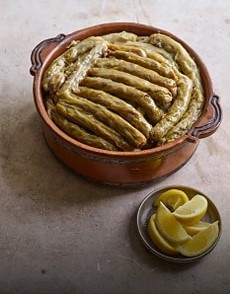
Malfoof dwalhi is another favourite memory. I was invited to Bukr’s house where his sisters and mother, aunts and grandmothers had all gathered to meet the lady who wanted to learn to cook dwhali. They lived on the road from Wadi Musa to Aqaba down a dirt track with views over Mount Aaron.
Dwlali is something that we have in the west, usually in tins, and is made with vine leaves, in that sense we think of it as a Greek or Lebanese dish. Malfoof is a huge white cabbage, a flattened circle the size of a bedside table. The leaves open out easily and are often so tender that they do not require blanching. The filling consists mainly of rice, sometimes meat, with onions and spices. The rice is part cooked initially and this trick enables the cabbage rolls to become tight as the rice takes up liquid and expands when cooked for the second time in a tomato and herb stock. The resulting cigar shaped cabbage farcies hold their shape together beautifully.  Sometimes vine leaf dwali is added for a contrast to the white cabbage. Traditionally it is cooked and layered in a large pan of a hundred or so rolls. When it was cooked we all sit outside on half built concrete walls overlooking Petra . A small goat eyes me from a nearby tree as the sun goes down over the red sandstone.
I think of all the dishes I have lived on my favourite to cook, share and eat was and still is Magloubah. It means upside down in Arabic and is a one pot rice and meat dish which is served on the largest silver platter that you can find. I have seen Magloubahs on platters the size of a double bed. It is a family staple along with Mensaf, the national dish, though I was never too keen on Mensaf as it usually came with camel milk which could lead to unexpected results!. Magloubah etiquette is very particular, you imagine a pie chart and you stick to your own section of food, Good natured arguments can prevail if a favourite morsel sits between yours and your neighbours imaginary line. Trade offs are made. Aubergine is often bargained for roasted cauliflower. Magloubah can be made with lamb, chicken or left meatless. If there is chicken, it leads to more bargaining as everyone has their particular fondness for a leg or a thigh. A neck or a breast. The neck is rightly a delicacy and it is a mark of respect to give it to to the head of the household or an important guest. It is a lovely thing to sit crosslegged around a Magloubah and watch as husbands quietly pass their wives a favourite morsel or a child playfully steals from a relative. Â It is served with labneh, a yoghurt and a salad of cubed and salted cucumber, tomato and lemon. Magloubah is a dish which, for me, has the same resonance as religious wafer or the Japanese tea ceremony but with more fun, laughter and mischief which is so indicative of Arabic culture
Many years ago when I lived in Hay on Wye I met Yotam Ottolengi at the festival. I asked him what his favourite food was and he replied without hesitation “Magloubahâ€. His interviewer asked where they could find the recipe and he said that he would not publish one as he had too many memories of his partners family and his mother cooking it. I don’t know if that has changed but I feel the same way about Magloubah for me is the closest food has ever got to spirituality.