
Handa and Loch Eribol were covered in fat red arrows when Peter, Jill and I looked at the weather app on Tuesday night.
‘Well, we could get there’ said Peter… ‘and very quickly!’ I added. There was a short silence before Peter pronounced gravely, ‘but, we’d never get back!’
It’s July in Scotland so you might think that sailing up along the west coast would not be too much trouble. However, the weather is whimsical in the British Isles. One of the deals that you have to make when you step on to a boat, of any worth, is that you go where the sea and the sky want to take you. The crew were all concerned about how disappointed the passengers might be but they have all sailed with us before and understand that nothing can be done about oncoming storms. Peter comes up with a plan to head south, avoid the worst of the weather and take in the whiskey Isles, the whirpool of correyvreckan, puffins and maybe some islands that we hadn’t been to before.
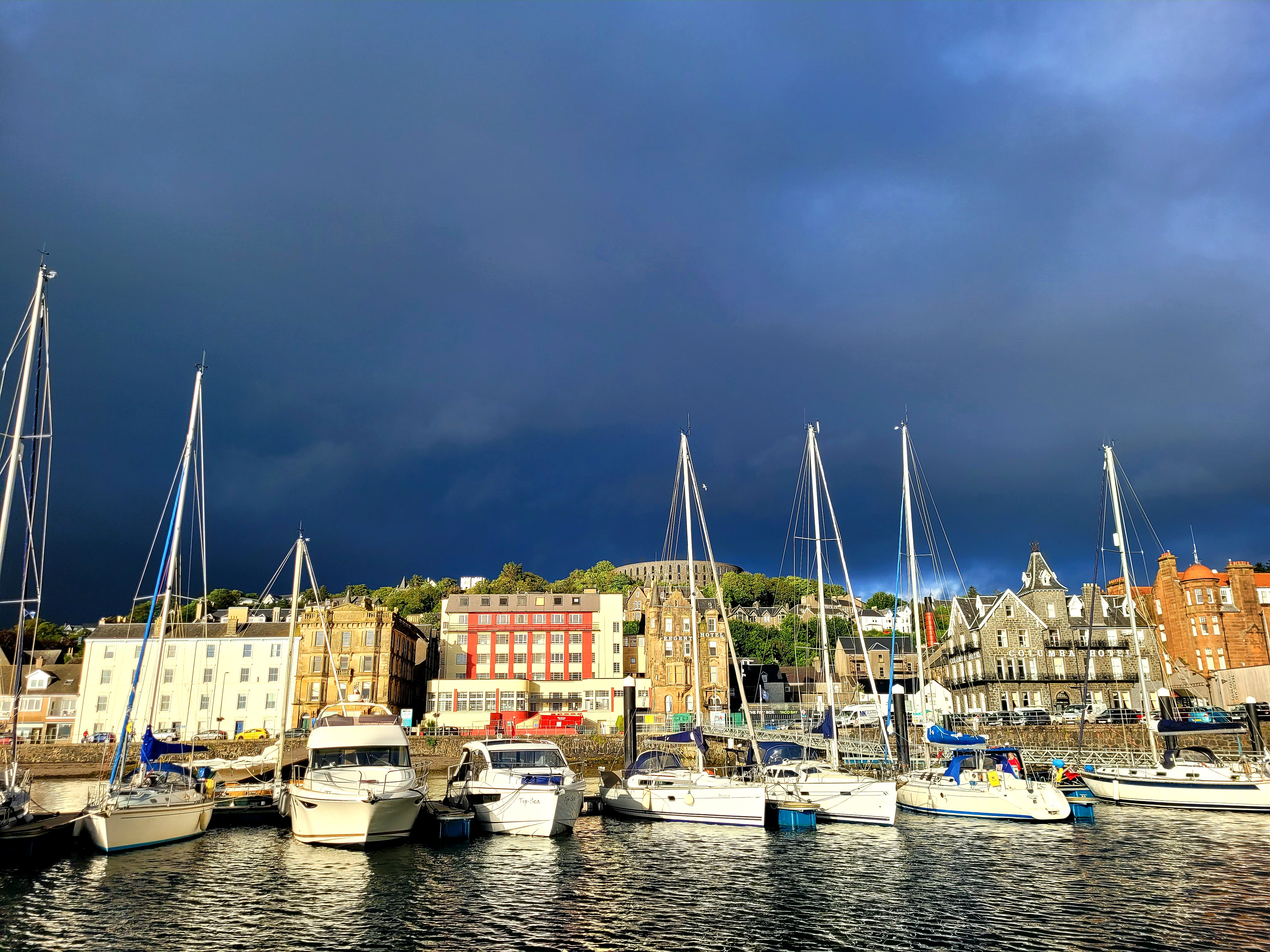
The next day the passengers arrive, quite literally, in dribs and drabs. The rain has begun and the wind is rattling through the halyards of the yachts and pinning us onto the pontoon. Michael and Pam are stuck on rail replacement buses and running very late due to the extreme conditions. Peter, our skipper, decides that it is best to alleviate the pressure and to stay alongside for that night. The alarming weather predictions are now south westerly 40mph and everyone agrees with the plan as none of us wants to sail in to the eye of a storm. Gales are fun for a few hours but their excitement quickly wears off. It is a holiday after all!. We have dinner alongside and take photo’s of the gorgeous sky over Oban caused by the low pressure.
Thursday 7th July
We leave Oban at 9.00am and head along the sound of Kerrera towards the correyvreckan whirlpool. The skipper says that it is best seen on a flood tide but we are to go past it at slack water. The whirlpool is created by the underwater features of a deep hole and a basalt pinnacle that rises from 70m to 29m at it’s rounded top. When the flood tide runs in between the islands of Jura and Scarba it creates standing waves and one of the largest maelstroms in the world. A tenth century Irish King wrote that the sea here
‘whirls around like moulding compasses, each of them taking the place of the other, like the paddles of a millwheel, until they are sucked into the depths so that the cauldron remains with its mouth wide open’.
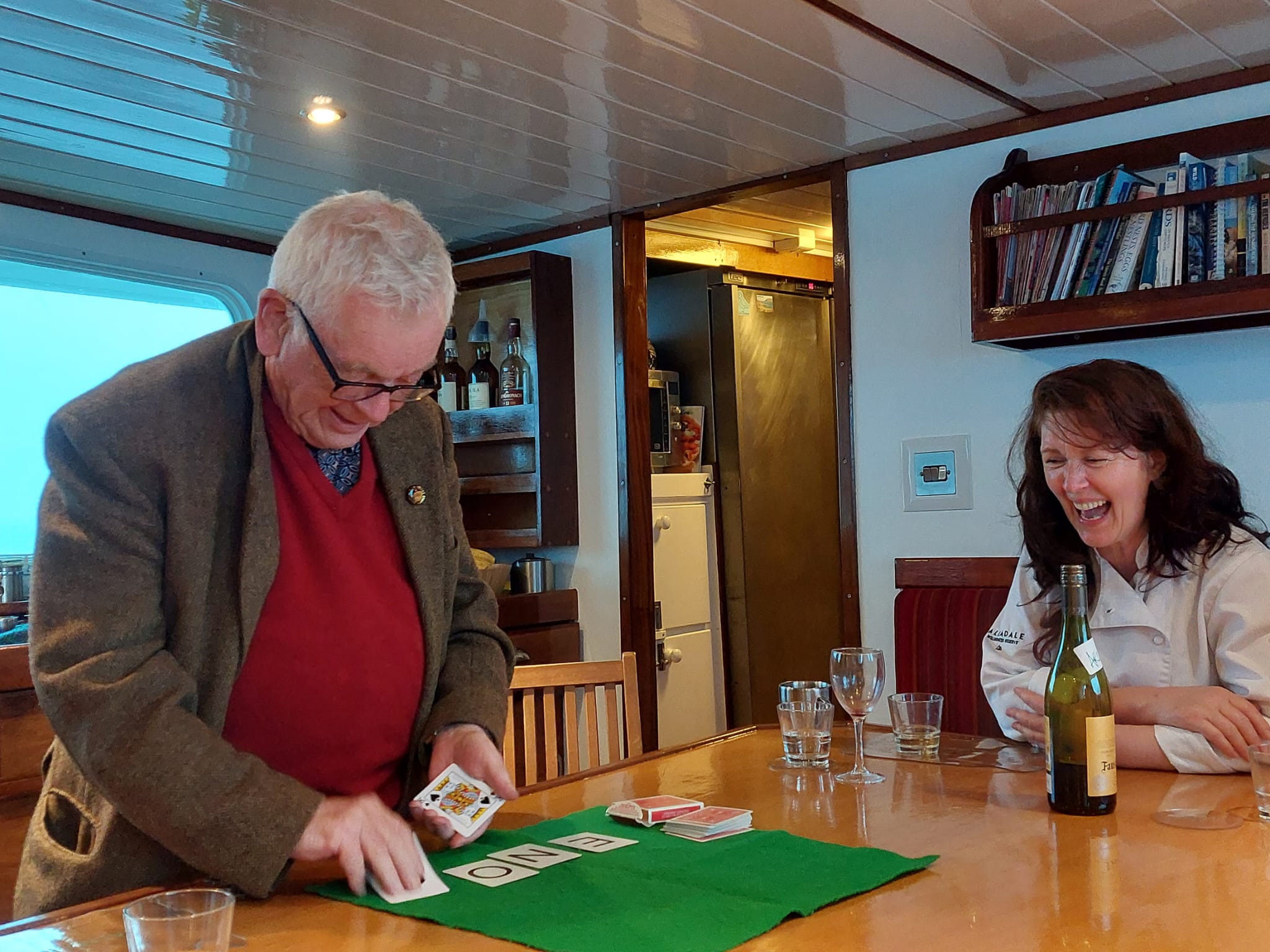
This morning the sea was like a mill pond and although I was slightly disappointed I thought that maybe it was a good sign. There is a cailleach who is supposed to inhabit these waters and hopefully she is allowing us a safe passage and a calm onward journey. We arrive at Tayvalich after lunch and all go ashore for a leg stretch and coffee at the excellent little café. It is such a pretty place with sculpture trails and art studios. Jill and I have time for spot of beach combing and collect seaglass along the shoreline. Back aboard for dinner and the passengers are treated to Mediterranean salmon parcels with homemade spicy seaweed chutney followed by an after dinner magic show. Archie has been sailing with Northern Light Charters since 2002. I sailed with him in 2015 and was always delighted by his slight of hand. I decide that I will change my seat every evening so that I can try to gauge how he does his tricks (if I might call them that?). Despite my cunning tactics I still have absolutely no ideas. I continue the cruise wary of saying ‘flibberdy gibbit gorgonzola’ in case a bowline shortens by half or a playing card turns up in an orange!.
Friday 8th July
We are away from Tayvalich at 9.00am.  It has come to light (!) that there is a more knowledgeable pharologist than me onboard. Ruth has sailed on Hjalmar on a lighthouse viewing cruise back in 2019. Although I try desperately to out lighthouse her (Pembroke head on the Falklands?) I have to concede that her erudition about all of the beacons of the sea is utterly comprehensive. She even knows about SPLATS!. We grin like lunatics as we sail past Skervuile which she tells me is a Stephenson lighthouse. Hjalmar arrives at Jura just after 11am and our passengers disembark for a few hours ashore. Everyone is back aboard for a lunch and I serve pan fried mackerel, salads and homemade goats cheese bread. I thought the bread was quite appropriate as Jura is famous for it’s wild goats who, some think, made it ashore from the Armada fleet. We up anchor at 3pm and head over to glorious Gigha where we settle in for the evening.
Saturday 9th July
Passengers wake to the smell of freshly baked pastries. The sun is shining and the island is so stunning we all want to go ashore. Jill and I organize packed lunches so that everyone has plenty of time to explore the island. It’s my visit to Gigha and I am instantly taken by how beautiful the sea looks as I walk along the pontoon. The seaweed is unfeasibly large and vibrant and the sand a pristine pale gold. I am on a mission to get hold of some of the famous Gigha halibut which is smoked on the island. I walk up to the shop and chat to the owner about how best to serve it and she recommends that I accompany it with pickled samphire. She also tells me that she teaches at the school and shows the children how to pickle the seed pods from wrack. Before heading back to the boat I pick up handfuls of seaweed bladders with the intention of preserving them. Everyone is back aboard for 4pm and Jill picks up the anchor. We all have freshly baked scones, jam and clotted cream en route to Islay home of, amongst other things, one of my favourite gins. Dinner is a pea and mint risotto with scallops and prawns followed by chocolate tart. It has been a fantastic day and I, for one, am very glad we are not battling through snotty weather around the Cape.
Sunday 10th July
Bacon butties for breakfast and a couple of hours ashore on Islay, also known as the ‘Queen of the Hebrides’. I manage to take an hour off for a run into port with Peter. We head for the Botanist visitor centre and arrive at six minutes past ten, it opens a ten, to find Steve propped against a pole sampling whiskey, ‘I’ve had two already’ he says merrily, ‘what a way to start the day!’. It makes me think that I must come back as a passenger, It’s looks like so much fun!.  Peter and I fill the dinghy with merry passengers and try to wiggle it free from the beach. Everyone is giggling as we glide slowly back to the boat…I can hear hiccupping over the sound of the outboard. Safely aboard and somewhat soused, we leave Port Charlotte and turn west towards the Rhinns of Islay. Rhinn is an old Irish word for point or promontory and it is where the word, rind, comes from. It is the outer edge of the most southern of inner Hebrides and has a ferocious little race. We pass another elegant Stephenson lighthouse established in 1825 on the Isle of Orsay and here the sea plunges and rises like a roller coaster. I vaguely wonder whether the term originally comes from sailors as nothing rolls about as much as a boat rounding a coastal headland. Lunch on the hoof as Mark used to call it. I decide on Welsh rarebit, which I am quite good at since moving to Wales. It is not simply cheese on toast it has beer, worcester sauce, eggs and mustard and is just the thing for being on the roll. Jill and I pass it around to passengers sitting out on deck. The two of us walk around with the most ungamely gait at sea, hopefully we don’t walk like that ashore ‘though they do say you can tell a sailor by their walk. We arrive off Oronsay at 3pm and everyone is quite excited as it’s a first for all of us. Mike tells me that St. Columba briefly lived here but, legend has it, that because he could still see Ireland he moved to Iona. According to the vita or Life of Saint Columba written by Adomnán at the end of the seventh century, the monastery on Iona had a number of satellites or daughter houses. The main one was named Hinba, it is not certain that this is the island of Oronsay but, William Watson proposes that Hinba derives from inbe, a Gaelic word meaning ‘incision’. This would fit with the great slice of tidal strand that intermittently attaches Oronsay to Colonsay. Oronsay is home to a 10th or 11th century priory dedicated to Saint Columba and some of our passengers head off to look at it. For some mad reason I take a wrong turn and end up in the heart of the Island where I am followed by a short eared owl. It laughs and makes stunning acrobatic turns as it follows for most of my walk and almost back to the landing beach. The island is full to the brim with bird life, angsty little oyster catchers chatter at me as I intrude on their homes. I hear the haunting call of curlews and see five lapwings near the boathouse. Some of our passengers swim in the crystal clear waters, others are floored by the history of the priory… quite literally in Mike’s case!
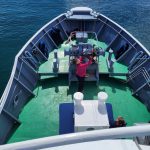
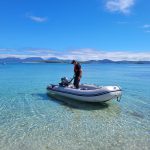
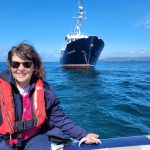
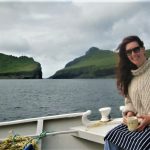
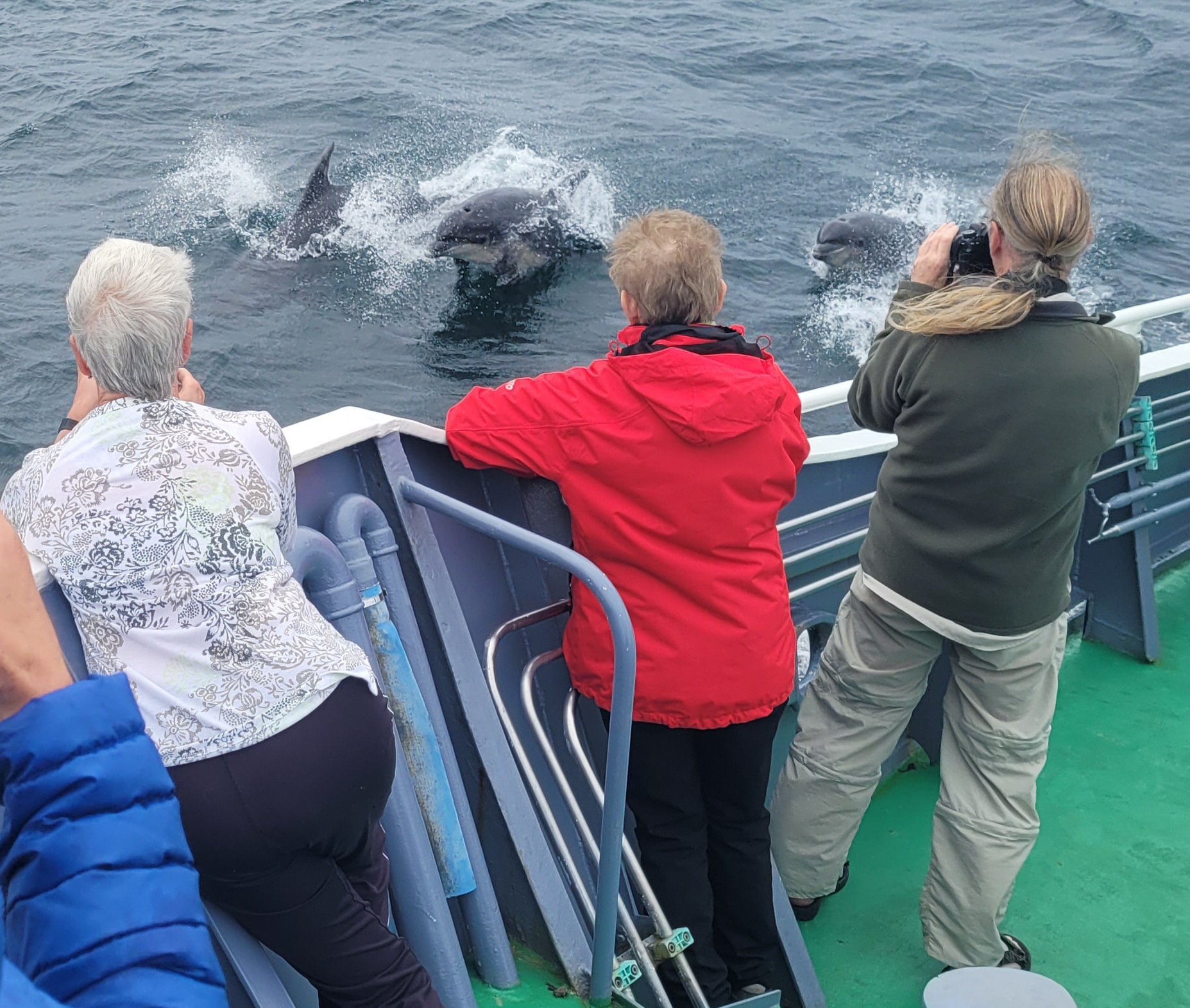
One of the most magical aspects of working aboard Hjalmar has been the sheer amount of knowledge that I have effortlessly acquired. I was very green when I first joined Mark in 2014 and I was always astounded, not only by Marks skill and proficiency as a skipper but, also by his expertise when it came to wildlife and island life. Mark was and, I am sure still is, a consummate enthusiast. Hazel, who has sailed with NLC six times remembers that he and Anna always exuded an intense enjoyment each and every time they saw dolphins or other sea mammals. Hazel said how rare she thought that was and she is right. You would think that no-one could ever be sick of seeing dolphins but, I have worked with people who are intensely bored by being at sea. Peter, Jill and I still joke about a skipper we knew who when the shout went up of ‘Dolphin!’ would respond dryly with, ‘seen them before’. I think if you don’t grin like a Lulu at the sight of these fabulous creatures then your life has taken a very unfortunate direction. Mark used to say that ‘dolphins love Hjalmar’ and after working on many other boats I realize that it is absolutely true. Maybe it is the shape of the hull, the speed she can reach or all of us grinning idiots hanging two meters above their heads but, they do seem to make a bow charge toward her from miles away. Later in the cruise we are joined by six bottlenose dolphins off Iona and I recognize them as dolphins that I had seen before. I have so many photographs and remember Mark showing me how he could identify them by the rope scars caused by finishing lines. It is this kind of attention to detail, I think, that makes a Northern Light cruise so unique.
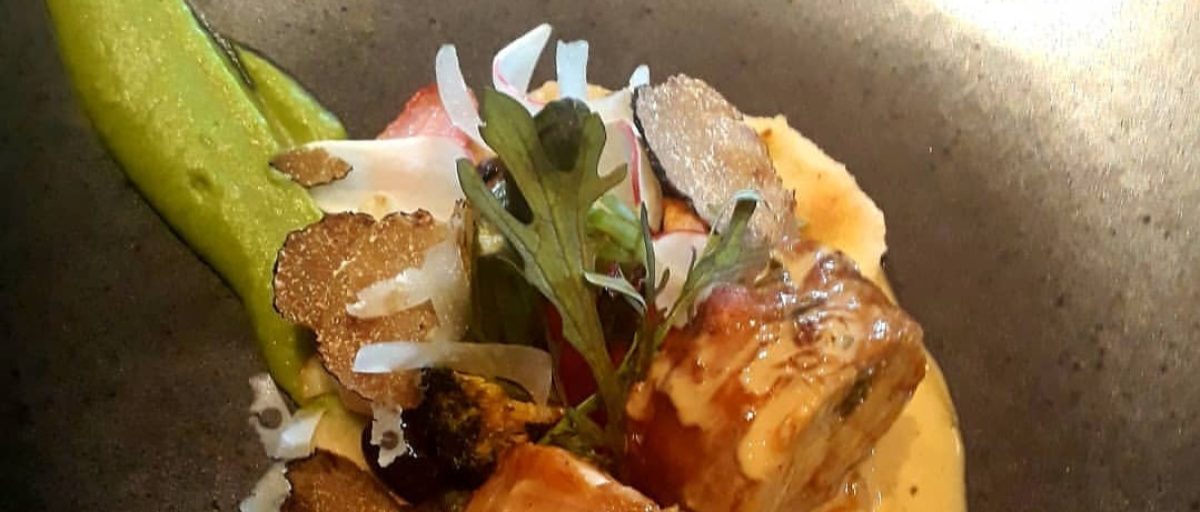
Everyone is back aboard for six o’clock, and Peter, Jill and I have a crew attitude adjustment drink in the wheelhouse. There used to be a piece of wood aboard with ‘crew attitude adjustment stick’ written on it in bold black felt tip. I am not sure what happened to the stick but, the drink is still part of the Hjalmar legacy and long may it continue. At dinner we all sample the Gigha smoked halibut, pickled samphire and mackerel pate followed by individual venison wellingtons. I make champ mash as I can see Ireland and have an odd yearning for it. During the night the anchorage develops a lolling swell which keeps Peter and Jill awake but, from my bunk below the waterline I am rocked to sleep like a baby in a crib. There are a few advantages to sleeping in steerage.
Monday 11th July
Winch operator, waitress and woman of innumerable talents, Jill, gets us underway at 9am and we roll along the west coast of Colonsay to Iona. None of us had ever been around the west of the island before and seeing as the tide wasn’t quite right for the sound we take the long way round. Jill drops the hook off the north end of the island but, Peter feels it is a bit exposed so we pick it up again and head for Bunessan. We are bimbling along slowly when a bottlenose dolphin joins us. Peter cranks Hjalmar up to dolphin speed and soon we have six playing around in our bow wave. Mike has told me that it is his birthday tomorrow and I wonder what I can get for a man who has spent so much of his life photographing wildlife. The answer, of course, is a photo of him with a dolphin giving him the eye!. I take endless photo’s and 99% of them are of the backs of peoples heads and a wash of grey sea…. but, finally ‘Derek’, as we call him, obliges me with a full on cete smile for the birthday boy.
At Bunessan passengers pop ashore for late afternoon walk. I notice that they seem to have acquired a bit of a nose for sniffing out pubs.
Tuesday 12th July
No tour of the southern islands would be complete without a jolly to Fingal’s cave. Even if you missed being told that it was part of the plan, you would know because at breakfast, every second person is humming the Hebridean overture. Mendelsohn’s association with Staffa is well documented but, Keats also visited the cave and fittingly described it as ‘the cathedral of the sea’. It’s basalt columns inspired the lines
This was architectur’d thus
By the great Oceanus!–
Here his mighty waters play
Hollow organs all the day;
Little did Mendelsohn and Keats know that the caves would go on to arouse and impel another great talent in the form of Steve. We are all treated to a remarkable musical journey via comb and paper as we sail over the northend of the Giant’s Causeway and on to Inch Kenneth. Many of us wept laughing and begged him to stop … but he wouldn’t. It turns out that in the land of bagpipes, the tuneless comb and paper player is most definitely king!
We arrive at Inch Kenneth and there is an opportunity for a walk before we head to Ulva for a sheltered evening anchorage and, amongst other treats, sticky toffee pudding for Mike’s birthday. Jill has organized us all to make dolphin bunting with the aid of her extensive art box. Jill could make an art gallery out of a midden tip. The drying room has become a museum of sea glass and shells. It is because of Jill that the boat always looks shipshape and Bristol fashion and she is a joy to sail with. We chatter on about everything and anything and hope that our galley banter is not too overheard by guests!. Jill once made me laugh so much that I nearly choked to death and as a result could not actually look at her without crying laughing for three days. Crewmates can make a hell of heaven and a heaven of hell and I have been extremely fortunate to have worked with people who are incredibly good at their job and also bloody good fun to work with. I think I will miss the camaraderie even more than the dolphins.
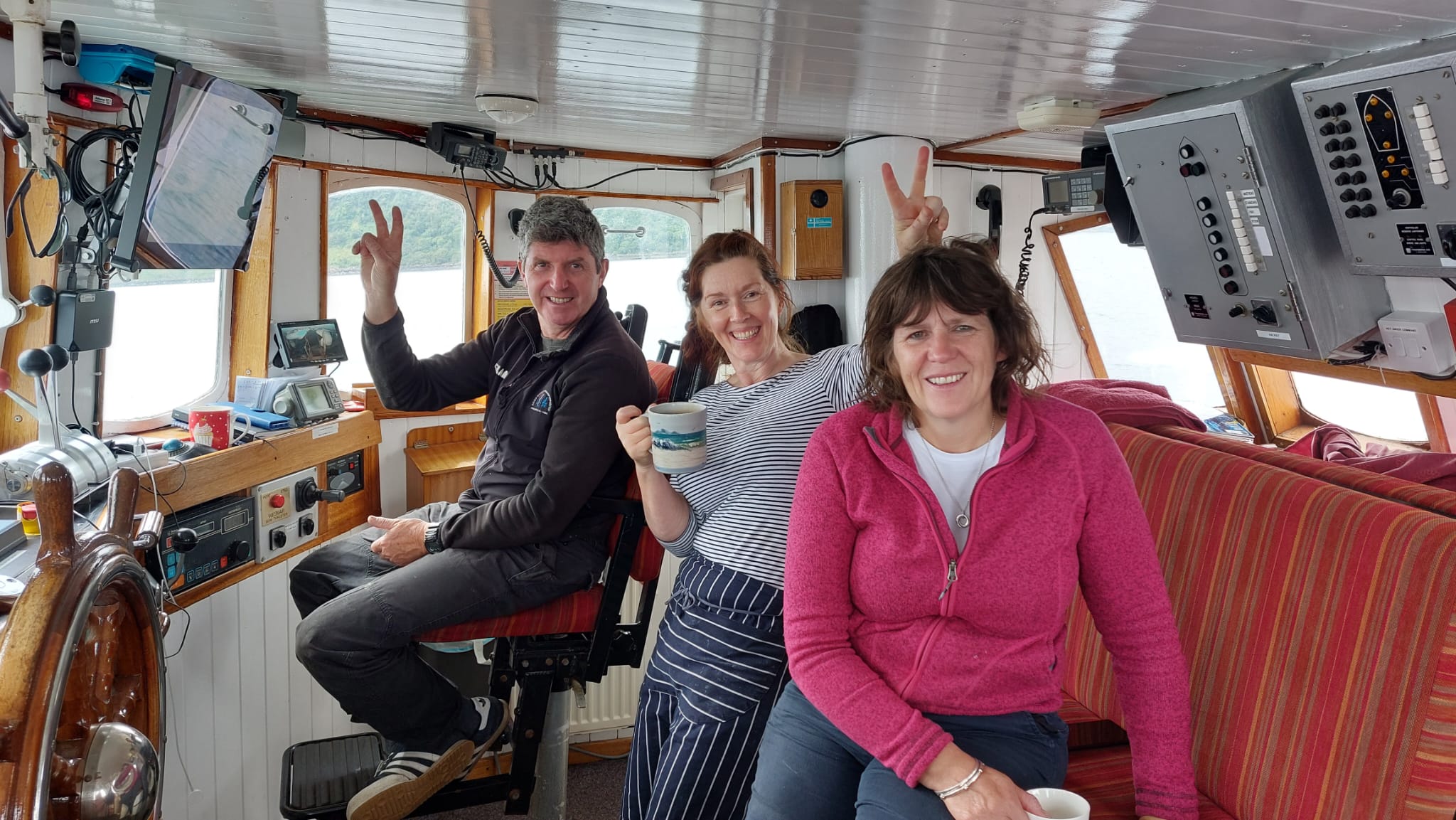
And on that note any final blog would not be complete without mentioning Tim Weir. For anyone who ever sailed with him you will know how exceptional he is and to those of you who didn’t … well, you missed something incredibly special.. like concorde or being part of the EU. I think all the passengers on this trip knew Tim and everyone says ‘Hello!’ and wishes him a happy retirement.
We rounded off another evening with more magic, mirth, mayhem and merriment and I got a kiss for taking the best photo of the birthday boy and Derek the dolphin!
Wednesday 13th July
Away after breakfast for the island of Lunga, home to puffins and men with enormous extensions. In the next few weeks the owners are considering closing the island because of the avaian flu which is wreaking havoc amongst the bird population. The Farne islands have already been shut and more sanctions are to be put in place. It is very sad and hopefully the puffins will avoid it as they will be off soon to spend winter rafting at sea. On a positive note I saw many more birds with sandeels in their beaks than I had seen in previous years.
Puffins go to sea for winter, they no longer have their distinctive plumage, they moult and lose their wing feathers which makes them flightless and vulnerable to weather and food supplies. Some vessels have reported huge rafts of puffins offshore but, it is thought that they are  largely solitary in winter and that they lead eremitic existences. Research and tagging has shown that some birds make one to three month trips in to the Atlantic and do not just stay in the north sea as was previously thought. Puffins it turns out are very like boat crew in that they are incredibly sociable and always on show in summer but, a bit of an enigma in winter!
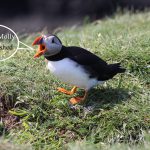
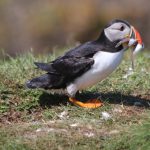
Back aboard and we pootle around the north of Mull to Tobermory. Jill and I effortlessly pick up the buoy, which is a pleasant surprise although the sodden ropes still bring up a harvest of seaweed onto the foredeck. I consider serving some for dinner but decide against it. Fish pie for supper with a haggis pastilla as an entre.
Thursday 14th July
A few hours ashore in Tob is almost an obligatory ending for a charter. Tob is the only place that I have ever seen otters in the wild. Last year there was one in the carpark eating a crab. The closest I have ever got to an Iolaire Suile na Grein was whilst drinking a coffee on the aft deck in Tob. The sky became very dark and when I looked up the ‘eagle with the sunlit eye’ was flying like a barn door ten meters above my head. It was white tails that led me to want the job aboard Hjalmar. I met Mark and Anna in Hastings in 2014 and after being offered the job Mark said very definitely, ‘you will see sea eagles’. I did and I still do, I was obsessed by them at that time. I had been to Iceland and Norway and never caught a glimpse. Since 2014 I have been incredibly lucky to see them so often. What I didn’t understand back then was just how much working aboard Hjalmar would open my eyes to everything else that the sea along the west coast had to offer. All the information I have learnt aboard has, undoubtedly, led me to going to Aberystwyth University. I hope to go on to read for a masters in Island Studies on Orkney in 2024. I feel incredibly fortunate to have been a small part of this boats history and to have continued to work aboard in the same spirit which Mark instigated so many years ago. I feel very sad to be leaving.
After lunch we steam along the sound of Mull and anchor off Kerrera. It’s an island that I have sailed past almost every summer for the past eight years but, one which I have never set foot on. I walk up to the iconic monument at the north of the island and consider how many places I have missed because I have been too busy to get underway or depart. My future will, hopefully, include the chance to spend more time on these spectacular islands instead of being moored off them. I sincerely hope that when I am ashore I will still see Hjalmar, her crew and passengers. I asked our eight guests how many times they have sailed on HB and totaled it up. Between us all we have knotted up over 100 cruises. That is not to say that we are an elitist club, it is more that, like anything really good in life, it just keeps getting better the more you do it.
I look forward to returning as a passenger.
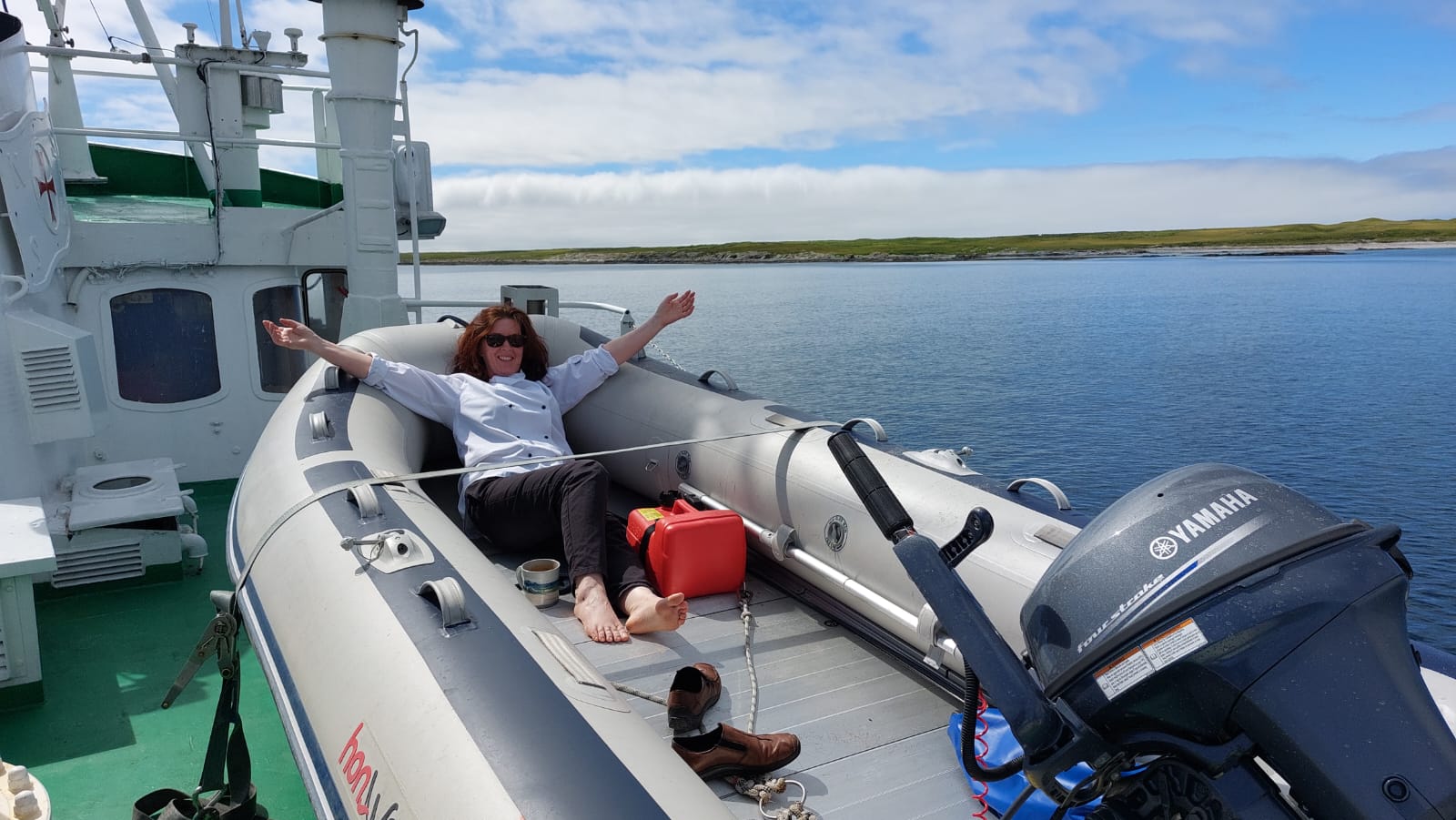
Thank you
Can I just give an ocean of thanks to all the crew I have sailed with over the years. To the skippers; Mark, Tim, Chris and Peter thanks for keeping me safe. To my bosun’s; Lulu, Anna, Sarah and Jill thanks for keeping me laughing. Thanks to Michelle for always making sure that I am abreast of the weird and wonderful dietary requirements (which I am sure some folk write when they have been drinking!!!) Despite the absurdity of victualling a 25m boat with enough food for 16 over 10 days it has, no doubt, made me a better chef. To all the passengers can I say a huge thank you for sharing your holidays with me. It has been an absolute, wonderfully exhausting, pleasure.
All the best to David and the new team. I cannot think of anything better than being part of Hjalmar’s ongoing legacy.